6 ASU Prep Digital Students are Scoring Goals—and Achieving Them

« Back  |  

With the help of ASU Prep Digital staff and educators, six American students are pursuing their dream of becoming professional soccer players in Europe without sacrificing their school work.   

Christian Chandler, Cameron Hein, Trace Higham, Antonios Loukas, Colin McGinnity and Christian Pöhlein have found success both on the pitch and in the classroom.

The six Sun Devils are immersed in the professional soccer environment of Bundesliga Club FC Shalke 04, where they live and train with 16 teammates from the U.S. and Canada on the famed Schalke Youth Academy’s Knappenschmiede campus in Gelsenkirchen, Germany. They practice twice a day, play matches once a week, and still manage to keep up with their studies.

It’s all thanks to a groundbreaking initiative that launched earlier this fall among ASU Prep Digital’s online school program, the famed Bundesliga talent department, and the International Soccer Academy. 

Not surprisingly, the program demands round-the-clock dedication by the young athletes. But that doesn’t deter the six ASU Prep Digital students participating.

“We’re responsible for our own learning and spending our time wisely around our soccer schedules,” said Hein. “During my first few months with ASU Prep Digital, I’ve built relationships with my teachers who help me with assignments, time management and other general questions.”

Each ASU Prep Digital student is paired with a Learning Success Coach who can help them navigate their workload based on their unique schedule and circumstances. 

“ASU Prep Digital makes school easier when you’re in a residential program like we are because it frees up your day to train in the mornings with our coaches,” added McGinnity. “I like being able to do sections of my courses throughout the day versus trying to cram it into one sitting. Our Learning Success Coach, Christine D’Antonio, is very helpful with anything we need, like adjusting schedules.”

ASU Prep Digital students enjoy the flexibility of being able to take their education wherever they go, with online school programs available 24/7 designed to help them learn at their own pace. They also have the opportunity to take concurrent college courses to help them earn college credits before they graduate. These are just some of the many benefits students enjoy when they join ASU Prep Digital’s virtual learning environment.

ASU Prep Digital’s coursework is designed to meet students where they are within their own academic parameters, all while putting them on a purposeful path to college. The virtual school encourages autonomy, responsibility and collaboration among the students, preparing them for college and setting them up for successful careers. It can make a world of difference for young learners who still want a full and rewarding academic experience while pursuing their extracurricular dreams.

The International Soccer Academy is the world’s leading youth soccer and professional career bridging program that provides pathways for elite young players aspiring to play abroad. Its FC Schalke 04 U18 Integrated Academy is a first-of-its-kind, highly competitive nine-month program that provides an authentic player development experience abroad. The inaugural squad was handpicked by scouts and coaches from the FC Schalke 04 sporting department after an extensive nationwide search and evaluation process. Only one in every ten players was approved by the scouts and offered a roster spot to join the Integrated Academy team.

To date, the team has competed against regional academy teams and are set to take on top-tier teams later in the season, including Hertha Berlin, Arminia Bielefeld and Fortuna Düsseldorf. So far this season, they’ve played ten games and posted an impressive record of 5-3-2 and netted 18 goals. The team’s grades are sure to be just as impressive.

To learn more about ASU Prep Digital’s flexible online school programs, visit asuprepdigital.org

Building a virtual program in your district? Examine these 3 factors in potential partners.

« Back  |  

In recent years, virtual programs have become more and more popular as brick-and-mortar schools explore solutions for students who have been temporarily quarantined, prefer to learn from home, or simply need more flexibility in their schedules. Across the country, virtual programs are becoming a need-to-have rather than a nice-to-have. But where do you start when evaluating the seemingly endless options? If you’re a district or school leader in charge of planning, starting, or transitioning a virtual program, you’ll want to make sure to evaluate your options thoroughly to avoid costly mistakes. Here are a few areas you should examine closely during your decision-making process. 

Funding model 
In the U.S., public school student funding is largely allocated on a per-student basis, contributing a significant amount to most districts’ budgets. Some virtual program models function as charter schools within a state, using their own staff and requiring payment as a percentage of your school or district’s per-student funding. “Historically those types of models have not proven to be the best in terms of test scores or student learning,” says Christy Cleugh, Director of National Partnerships for ASU Prep Digital. Instead of sacrificing your per-student funding, she recommends looking for providers or partners your school or district can pay directly. In addition, if your district has curriculum adoption funds, you might opt for virtual courses that can be deployed using your own teachers and staff. “This allows for district-level control,” says Cleugh, “Not only that, but it helps ensure providers are actually there to support your local communities, your local students, and their outcomes.” 

Instructional strategy
One common misconception in developing a virtual program is the assumption it only requires an investment in digital curriculum or courses. “Curriculum makes up only half, if not less, of your digital school,” says Teresa King, Director of National Partnerships for ASU Prep Digital. “Your success will be contingent on the power of your instructional model, and you cannot have an online program without online teachers.” You should expect that the majority of your budget for any virtual program will be used to support recruiting, training, maintaining, and evaluating virtual teachers, whether you plan to leverage your existing staff or bring on additional virtual instructors through a partnership. Regardless, the most successful virtual programs all have one thing in common—full-time, high-quality, and professionally certified teachers. “You want online instructors that engage with students and their families,” says King. “That engagement piece is what keeps online students coming back and makes your program successful.”  

Stakeholder involvement 
If you’re considering working with a for-profit education company, take some time to evaluate all the stakeholders involved, including existing or potential shareholders. It’s not uncommon for educational companies to be publicly traded, meaning they’re beholden to shareholders who expect them to continually grow and expand their bottom line. This isn’t always a negative, but it can become one if the company has a history of churning through students and enrollments just to meet its business goals. “I always suggest doing a simple Google search regarding any potential partners,” says Cleugh. Specifically, you should look for any history of legal action, lobbyist activity, and even other names the company may have operated under. “If you’re looking for a collaborative partnership, do your homework,” says King. “Examine your options so you can make an educated choice about who you want representing you.”

Partner with ASU Prep Digital
ASU Prep Digital is an accredited online K-12 school providing districts with single online courses, full-time virtual programs, innovative learning recovery solutions, and professional development options. We would love to collaborate and develop a customized program for your school’s needs. For information about partnering with ASU Prep Digital, please email partnership@asuprep.org.

January Newsletter

« Back  |  

ASU Prep Digital’s mission is to design new models for educational success to raise academic achievement for all learners.

Note from Your Director

Dear ASU Prep Digital Students and Families, 

Welcome back from Winter Break! Our teachers and staff are eager to connect with all of you as we begin our Spring semester. You will receive many welcome calls and communication over the next few days (if you haven’t already). There are a lot of exciting events and stories of success occurring throughout ASU Prep Digital, and we’re proud to showcase some of them below. Be sure to check out the information on our upcoming 2nd Annual ASU Prep Science Fair along with opportunities to observe, reflect, and learn about International Holocaust Remembrance Day on January 27, 2022. 

Sincerely,

Dr. Laura Maloney, Director of Academics

Mr. Michael Kasper, M.Ed, Director of Academics


Meet Our Teachers

Christy Birch, Kindergarten Teacher

Christy Birch is one of our amazing Kindergarten teachers. She “believes in the power of education to change the world, as corny as that may sound. Innovation, healing, progress, and peace are all dependent on a society that values knowledge from literature, arts, science, history, and facts. In my small way, as a teacher, I contribute towards that immense ideal. Everyday at my job, I am lucky enough to spend time with students I care about, families I can support, peers who inspire me, and leaders who push me to be better.”

Lindsay Mackie, 7th and 8th grade Social Studies Teacher

Mrs. Lindsay Mackie teaches 7th and 8th grade social studies for our U.S. students and teaches U.S. History for our Ukrainian partnership students.  She is a former U.S. Army Staff Sergeant that LOVES teaching and has been working as a teacher for over twelve years.  Mrs. Mackie officially “lives” in Ohio but is currently enjoying the mild winter in Florida as a traveler in her motorhome with her husband and two Australian Shepards (Brody and River).  While in Florida, Mrs. Mackie has been staying on military bases and has enjoyed seeing dolphins, manatees, alligators and even just witnessed a SpaceX Rocket launch! This is Mrs. Mackie’s first year working with ASU Prep Digital and we are THRILLED she’s with us!

Sean Murphy, High School Science Teacher

Mr. Sean Murphy is one of our newest full-time H. S. Science Teachers. When asked why he chose ASUPD to work and teach, Sean responded: In combination with a growth mindset and heart of a teacher, I thrive in environments that require flexibility and change. Working at ASU Prep Digital has enabled me to maximize my skill set as well as provide me the opportunity to collaborate with an innovative team that is on the cutting edge of online education. Sean added, in our ever-changing global economy, our future citizens require an education that embraces 21st-century skills. Integrating technology with education will not only enable my students to be successful in the future but also produce leaders in sectors of industry that have not yet been created. I LOVE to teach ALL things SCIENCE!!! From the nuances of electrons in quantum mechanics to aquatic Keystone Species in our oceans. When he is not teaching our wonderful students, Sean loves to watch movies, exercise outdoors, & mountain climb with his family.


School Updates

Elementary School

Learning Pods Are Coming to ASU Prep Digital

Learning pods, also known as “pandemic pods” became popular when schools across the world became remote due to the Covid-19 Pandemic. It quickly became an innovative way for students and families to connect and collaborate in a safe, controlled environment. ASU Prep Digital is excited to announce that in January 2022, we will be introducing learning pods in our K-5 Elementary school with the help of our teachers and Learning Success Coaches (LSCs). Learning pods will be a completely optional opportunity for students and families and once created, will be maintained by the learning pod itself. 

Mix-It-Up Art Club

From turkey paintings to Christmas tree sculptures, check out these art projects done by the Mix-It-Up art club students.

Veterans Day Projects

Our 5th graders honored Veterans Day by drawing pictures, creating videos, and writing about what Veteran’s Day means to them. Check out the projects!

Native American Projects

Our 4th graders learned about Native Americans and their different types of dwellings. Check out their recreations here!

Learn more about our Elementary School here: https://www.asuprepdigital.org/elementary-school-program/

Middle School

Southwest Wildlife Conservation Center Field Trip

We had a great time learning about native mammals and about the rescue, rehabilitation and release program at SW Wildlife.  We were able to get up close and personal with these amazing creatures! – Jessica Berger, MS Science Teacher

The Spark

The Spark is a production of the ASUPD Sparky Broadcasting Club. It is a student-created video series made to bring some ASU entertainment and information into ASUPD and student lives. Check back regularly for new episodes! We strive to produce one episode every week. You can view The Spark here!

Learn more about our Middle School program here: https://www.asuprepdigital.org/middle-school-program/ 

High School

Summer Opportunity for HS Students

W.P. Carey School of Business at Arizona State University has a unique summer 2022 program. Selected students will spend the summer working with W.P. Carey, and will take the ASU Prep Internship digital course in the fall. Students who are interested must complete the following rigorous application process:

Benefits:

  • Students selected for the Fleischer Scholars summer program benefit from a multitude of resources, and they learn necessary skills for success in college and beyond.
  • Receive a free laptop
  • Obtain free college course credit
  • Learn the keys to academic and professional success
  • Discover academic and career opportunities
  • Interact with current W. P. Carey students, faculty, staff, and alumni

Eligibility:

  • Arizona high school student graduating in 2023 or 2024
  • Teacher or professional recommendation
  • Involvement in the school and/or community

Application deadlines

  • Jan. 15, 2022 – Early Consideration
  • Feb. 15, 2022 – Final Consideration
  • March 1, 2022 – Late Consideration

Click here to Learn More.

Social Media Club Openings

The ASU Prep Digital Social Media Club has openings. Students will have the opportunity to gain knowledge of social media channels, strategy as well as leadership, collaboration, and communication skills. Students will have the opportunity to apply their skills in real-world situations and internship opportunities. Join now!

Student Feature
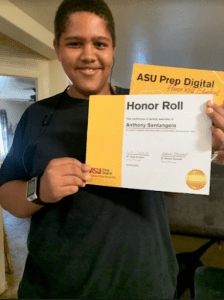
Anthony is thriving at ASU Prep Digital. He is finding the connection and support he has been looking for in his education! He masterfully embraced all we have to offer- attends live lessons, reaches out for help, remains in weekly contact with his LSC, and engages in Homeroom! He worked extremely hard to earn Honor Roll last year, and now is continuing to challenge himself academically by taking an ASU Concurrent Course as a 10th grade student! He is respectful, responsible, and all around wonderful student and person!

International Holocaust Remembrance Day

International Holocaust Remembrance Day is observed on January 27, 2022. ASU Prep Digital is proud to offer students and staff a variety of ways to learn, reflect, and remember this important event in history. We will be hosting an art challenge, a book review, a poetry contest, along with a journal reflection and even a Flipgrid “call to action” opportunity. Each activity is designed for students to choose how they want to remember and observe, along with bringing awareness to their fellow classmates and school community. This experience will culminate in a gallery where students will be able to view the work of their peers between January 26th-28th, followed by an opportunity to participate in a guest speaker presentation of a Holocaust survivor on January 27th. If interested in learning more about how you can participate in this event, please click HERE for high school students or HERE for middle school students.


ASU Prep Digital Blog

Virtual Learning Grows During COVID

Virtual learning in K-12 education continues to grow due to the health threat caused by coronavirus variants and the assistance this learning model can provide to at-risk students, according to two papers released today by Pioneer Institute. Read more.

How to Thrive as a Digital Teacher in 2022

It can be hard to keep New Year’s resolutions, but if there’s one that teachers should commit to when January rolls around, it’s to enroll in one of the new training courses debuting in 2022 on the ASU Prep Digital online training portal. Read more.

ASU Prep Digital Students Are Changing the World

Global leaders could learn a thing or two from a handful of ASU Prep Digital 8th graders and their peers half a world away. As part of the Global Leadership Exchange pilot program, this small group of online middle school students is tackling herculean challenges on a global scale, from human migration, plastic pollution and climate change to deforestation, clean water and access to technology. Read more.


Academic Support

Academic Enrichment Programs 

When student curiosity is ignited, their learning knows no bounds. Our selection of academic enrichment programs let students join small groups that dive deep into learning areas of their choice, advancing their subject knowledge, building their confidence, and increasing their critical-thinking and problem-solving skills. 

ELEMENTARY

  • The beginning of the semester provides an opportunity to do better, make changes, or maintain excellence. Our families, students, and staff members have faced many challenges already this year and the illness associated with Covid-19 is not letting up for some. Please continue to bear with us with patience and understanding as we continue to team teach when our teachers are out sick. 
  • LSCs are offering students and families a time to sign up and discuss success plans for the second semester.
  • New Families have the opportunity to participate in a New Parent Orientation as well as an Open Office Hours later in the month to support. These sessions are hosted by LSCs.

MIDDLE

  • Homeroom starts this Wednesday, January 12 at 10am AZ with your student’s Learning Success Coach (LSC)! This week, the theme is “Starting Your Semester Off Strong”
  • Live Lessons for spring courses will offer strategies for navigating courses and utilizing resources to stay on track this semester. 
  • Teachers are calling students and parents/guardians to offer a ‘welcome back’ for returning students and ‘welcome to our school’ for new students. This is your opportunity to ask questions and get to know your teacher and LSC. 

HIGH

  • The start to a new term can present a lot of new challenges for digital students. At the high school level, all teachers will offer a “Welcome Back” session the first week of course start and provide a Welcome Announcement on the course home page to offer tips for success, links to helpful resources and pacing guides for students to more easily manage their assignment workload. Additionally, students and parents/guardians should receive a phone call from 100% of their assigned teachers within the first few days of the course start date. During this call, teachers will introduce themselves, provide a summary of the course expectations and answer any questions. Building a relationship of support with all of our students and providing a welcoming learning environment is our primary goal at ASUPD!

Socialize and Accelerate Learning 

We’re building a supportive academic culture that lets students connect with others who share their passions and academic interests. Not only does this make learning more fun, but it allows students to encourage each other on their learning journeys. 

Learn more about our Academic Support Program offerings here.


Get Connected With ASU

ASU Family Virtual Yoga

Invite healthy fun into your home. Tune in for free Zoom yoga classes designed with young yogis in mind. Classes will be easy to follow for all ages and cover concepts like healthy stretching and mindful breathing. No materials are needed to participate, but comfortable clothing and a yoga mat are recommended. Yoga instruction will last 45 minutes. Register now!


Immersion Health and Safety Updates

Face Coverings

Face coverings are strongly recommended for everyone who is in a building on any ASU Prep campus. Please strongly consider having your child wear a mask in school. We have also strongly recommended this for our teachers and staff.

Face coverings work to reduce transmission of the virus and the CDC recommends that people wear face covers in indoor public settings regardless of vaccination status in areas of substantial or high transmission of the virus. Arizona Department of Health Services Director Dr. Cara Christ has endorsed this recommendation and has urged the public to follow suit.

Keep all students who are sick at home.

This also applies to students sick without a fever as the COVID-19 virus does not always induce a fever. Please also notify the health office when your student is out sick. 

Keep in mind guidelines regarding frequent hand washing, social distancing, minimizing contact with those not in your household, etc. We encourage students to wash their hands as soon as they get home from school and take any other precautions your family deems necessary, such as a clothing change.

The vaccine is the best protection against COVID-19 in reducing serious illness, hospitalization and the spread of the virus. ASU strongly recommends getting the vaccine for our teachers, staff, and students (if your student is old enough). Reach out to your provider for more information.

Eat healthy, exercise, get adequate sleep, drink plenty of water, etc. to help your immune system.

COVID Mitigation and Quarantine Procedures

  • Daily cleaning protocols will continue and staff will leave items used in the classroom out for mist cleaning.
  • Common school areas will be open (lunchrooms, libraries, etc.) and will be cleaned using daily cleaning protocols.
  • Hand sanitizer and frequent hand washing will be available and encouraged.
  • Drinking fountains can be used and are included in daily cleaning.
  • Shared objects in the classroom can be used and are cleaned nightly.
  • Physical distancing will be maintained when feasible, with students to have 3 feet between them.

Quarantine procedures will be followed:

  • Contact tracing will be done by a nurse.
  • Students will be sent home if identified as a close contact
  • Close contacts are determined through the information we gather during contact tracing, as well as consulting with the Maricopa County Department of Public Health
  • Students who are asymptomatic can test on Day 5 or after and with a negative test and no symptoms may return to school.

Family Communication

  • If your student has been identified as a close contact of someone who is COVID-19 positive, you will be notified. We do not notify students who were not in close contact. 

Donate to ASU Prep

Do you support nonprofits through end of year giving? When you donate to ASU Prep, your gift impacts the children at our schools. You can dedicate your contribution to one of the following areas:

  • Academic Enrichment
  • After School Clubs
  • Innovations
  • Field Experiences
  • Arts and Culture
  • Sports and Athletics
  • General (the school picks)

Additionally, Arizona residents may qualify for a tax credit (up to $200 if filing single, up to $400 if filing jointly) when they donate to ASU Prep. Please consult a tax adviser to discuss your tax credit eligibility or questions.



Check out the 21-22 School Calendar and the 21-22 Parent Handbook for additional resources.
Make sure to #RepThePrep and check out the ASU Prep School store!


Virtual Learning Grows During COVID

« Back  |  

Article originally published on Pioneerinstitute.org

Virtual schools are safe and flexible for families and at-risk students

BOSTON – Virtual learning in K-12 education continues to grow due to the health threat caused by coronavirus variants and the assistance this learning model can provide to at-risk students, according to two papers released today by Pioneer Institute.

Virtual Learning, Concrete Option (download)

Online and On Course (download)

Though the two factors are distinctly different, their impact is the same, as more families have been prompted to explore the possibilities of digital learning. They have discovered that expert virtual learning differs from what many parents and students experienced after schools unexpectedly shut down in March of 2020. Others have seen how the use of technology can address the unique needs of certain children and high schoolers, the two studies report.

The papers are authored by Julie Young, founder of Florida Virtual School and managing director of Arizona State University Prep Academy and ASU Prep Digital, and William Donovan, a writer and former journalist. The reports also draw on government information, foundation studies, and interviews with experts in the digital learning field.

“Virtual learning, using computers and the internet to study courses taught in the classroom, isn’t meant to replace an in-school education,” says Young. “But it provides a genuine alternative for families who have challenges that interfere with attending brick-and-mortar schools.”

The level of parental demand for remote instruction has declined from the peak of the shutdown surge, as students returned to school full time in 2021. But states and school districts in California, Florida, North Carolina, Utah and elsewhere in the U.S. are continuing to expand their pre-pandemic virtual learning capacity to accommodate further enrollment growth.

In “Virtual Learning, Concrete Option,” the authors explain why established virtual schools and their programs are much different from the frantic switch to remote teaching that schools were forced to make after the 2020 closing. That hasty rush soured virtual learning for many families. True virtual schools apply years of experience to create courses designed for the online platform. Courses are developed by teams of designers, expert in user interface, graphics, instruction, and curriculum.

Most of the more than 330,000 students who attend one of the nearly 500 full-time virtual schools in the U.S. did not experience the same disruptions as in-class students, the authors state.

Virtual learning is a specific form of education that takes place through an online platform. It has often been swapped with the term remote to describe out-of-classroom learning as if they were the same. Virtual learning is much different from what was often a hasty attempt to remotely push classroom instruction through a computer screen when schools were closed. Remote learning is a broad description of what was happening.

In the second paper, “Online and On Course,” Young and Donovan lay out the benefits that virtual learning can provide to at-risk students, particularly minority students and those from low-income families. Those students often face personal or social issues such as violence in school, teenage pregnancy, or the need to work to help support their family. Unable to attend school, many drop out and ultimately fail to graduate.

The primary advantage that digital learning can provide those students is to free them from restrictions that tie learning to set hours in a specific place.

“Too often we limit students in a system in which time is fixed and learning is variable,” says Young. “Online learning flips that system and makes time variable and learning fixed. Enabling students to work at their own time and pace is a way for them to meet their academic requirements and their responsibilities outside of school.”

While touting the virtues, the authors advise parents to scrutinize digital programs closely. Their quality and effectiveness vary widely. Students are poorly served by point-and-click assessments with no engagement, virtual schools with videos instead of real teachers, and programs without pacing and scheduling support.

A key differentiator between questionable and quality virtual programs is adherence to the National Standards for Quality Online Learning, which includes standards for virtual teaching, programs, and courses. A competent virtual program should adhere to those standards.

The papers offer many recommendations, including the need to build out the digital learning infrastructure with broadband access to rural communities; investment in training teachers in virtual instruction; and the need for districts to be more forward-thinking in school designs such as hybrid models, learning pods, and micro-schools.

About the Authors

Julie Young is ASU Vice President of Education Outreach and Student Services and Managing Director of ASU Prep Academy and ASU Prep Digital. She is a visionary CEO, educator, and entrepreneur passionate about leveraging tech­nology and building innovative school models that put stu­dents at the center of every decision. Under Julie’s leadership over the last four years, ASU Preparatory Academy has grown exponentially in both enrollment and global impact, currently serving more than 7,500 full-time K–12 students and over 400,000 student enrollments in school partnerships around the U.S. This unique program offers students an accelerated path toward college admission and careers of the future with the chance to earn concurrent high school and university cred­it, shortening time and cost to degree. Julie was the founding President and CEO of Florida Virtual School (FLVS ®), the world’s first virtual statewide school district that began as a small grant initiative and grew to become the largest public K-12 program in the U.S., serving more than 2 million stu­dents in 50 states and 68 countries.

William Donovan is a former staff writer with The Provi­dence Journal in Rhode Island where he wrote about business and government. He has taught business journalism in the graduate programs at Boston University and Northeastern University. He received his undergraduate degree from Boston College and his master’s degree in journalism from American University in Washington, D.C.

About Pioneer

Pioneer’s mission is to develop and communicate dynamic ideas that advance prosperity and a vibrant civic life in Massachusetts and beyond. Pioneer’s vision of success is a state and nation where our people can prosper and our society thrive because we enjoy world-class options in education, healthcare, transportation and economic opportunity, and where our government is limited, accountable and transparent. Pioneer values an America where our citizenry is well-educated and willing to test our beliefs based on facts and the free exchange of ideas, and committed to liberty, personal responsibility, and free enterprise.

ASU Prep Digital Students Are Changing the World

« Back  |  

Global leaders could learn a thing or two from a handful of ASU Prep Digital 8th graders and their peers half a world away.

As part of the Global Leadership Exchange pilot program, this small group of online middle school students is tackling herculean challenges on a global scale, from human migration, plastic pollution and climate change to deforestation, clean water and access to technology.

Driven by ASU’s pedagogy of discovery-based learning, the Arizona students have partnered with peers in South Africa to develop real-world solutions to some of the most pressing social and geopolitical obstacles of our time.

Led by teacher Shawn Carey, the six ASU Prep Digital students and nine students from the Valenture Institute (an online high school in South Africa) are engaged in cross-cultural collaboration to examine these issues through a global lens, understand drivers and affect positive change. And they do all of this virtually in an online school setting.

While studying human migration, ASU Prep Digital students put the topic into greater context for their South African peers by sharing information about South American caravans flocking to the U.S. At the same time, Valenture students brought to life the challenge human migration from Zimbabwe is having on South Africa.

“Although world challenges are shared, because we live in different parts of the world, it can be difficult to understand differing views and perspectives,” said Ava Villa Martinez, an ASU Prep Digital student pursuing a career in which she can make a positive global impact. “Kids our age often don’t have a chance to weigh in on such important issues. Being part of this virtual school program allows us to learn different perspectives and come up with ideas that could really work.”

Working in two-week sprints, students collaborate online in small groups to immerse themselves in a problem within a global, cross-cultural context. They explore ways to tackle a global challenge and define the audience they need to mobilize, then imagine and activate creative solutions, thoughts and ideas in the form of presentations, public service announcements and podcasts.

“The Global Leadership exchange has made my mind come alive,” said Patrick Daily, another ASU Prep Digital Student in the virtual program. “When you take a deeper look into an issue, your eyes are opened to how some policies and restrictions can hold back progress.”

Having already explored issues of human migration and plastics contamination, Ava, Patrick and their peers will tackle climate change in the coming weeks.

Listen to KTAR-FM news story about this program.


To learn more about the ASU Prep Digital Global Leadership Exchange program and what this enterprising group of young people will achieve next, please contact admissions@asuprep.org.

How to Thrive as a Digital Teacher in 2022

« Back  |  

It can be hard to keep New Year’s resolutions, but if there’s one that teachers should commit to when January rolls around, it’s to enroll in one of the new training courses debuting in 2022 on the ASU Prep Digital online training portal.

Arizona teachers can enroll in both of these courses for free and earn Professional Development credit for completing them.

Educators face the increasing demand to offer both in-person and virtual learning opportunities for students navigating their education in a post-pandemic world. These two training courses are designed to immerse teachers in the evolving landscape of virtual learning by giving them the tools to succeed as an instructor of digital and blended content. Each covers a series of important topics:

Thriving as a Digital Teacher 
In this course, you’ll learn how to translate your teaching experience to an online environment and thrive as a digital instructor. You’ll master everything from the basic tools and tactics needed to effectively teach online to best practices and commonly used terminology.
Learn More >

Introduction to Blended Learning
Blended learning helps teachers meet the diverse needs of the students they work with. Having transitioned their education to an online setting during the pandemic, thousands of students are now looking for hybrid learning options where they can continue their studies partially online and partially in the classroom. In this course, you’ll learn how to merge in-person teaching methods with online learning technology to create a powerful and personalized hybrid learning experience.
Learn More >

As we enter the new year, there’s much that’s uncertain, but one thing is for sure: online learning is here to stay. ASU Prep Digital’s teacher training portal is ready to equip teachers with all they need to thrive in a digital classroom.

Visit the ASU Prep Digital training portal to download free resources, watch professional development videos or enroll in an asynchronous online training course. Simply sign up for a free account and get started today. 


Supporting Students Who are Staying Digital

« Back  |  

With a new semester right around the corner, many families may be reconsidering their children’s learning environment, specifically when and if they should send their kids back to a brick-and-mortar school. While many of us expected to be fully back to face-to-face learning at this point, the reality is families may not feel ready for the return, whether due to uncertainty regarding COVID-19 variants, newly established routines, or even a preference for distance learning. How should your school prepare for this “new normal”? Here’s our recommendation for the most impactful actions your school can take to establish best practices and maximize support for your virtual students and families. 

Make a Plan
When reviewing how your school will support students learning from home, consider what is working and what’s not. “Try to think about what was learned when schools shut down, and pay close attention to fixing those things that didn’t go well,” advises Megan Grothman, Global Partnership Manager for ASU Prep Digital. “The other important thing is to lean on people who are experts in the field—there’s no expectation that a school district has to know it all or have it all figured out, especially when there are people out there to help.” For ideas, ask other district leaders or potential school partners about challenges, opportunities, and what’s worked best to support virtual learners. 

Ensure Access to Technology
Equitable access to computers and the internet are a must for remote students and essential to their success when learning virtually. If your school applied for funds under the Federal Communications Commission’s (FCC) Emergency Connectivity Fund in 2021, you can allocate that money for purchasing equipment such as laptops, tablets, and home internet access for students. In addition, schools can support families with assistance in applying for the FCC’s Emergency Broadband Benefit Program, which helps families access discounted broadband and technology devices. 

Additionally, continue using any digital resources that were effective for your school during previous distance learning efforts. Using familiar tools ensures students are equipped to navigate the online learning environment if or when they find themselves back at home learning. Blended learning strategies are key in establishing equitable usage and benefits of educational technology. 

Get Families Involved
Families are a critical component to the success of any distance learning program, so ensure your school is focused on ways to engage parents and make it easy for them to support their child’s learning. “The idea is to create an environment where parents feel like they can trust your commitment to their child’s success during distance learning,” says Grothman. “It’s also important to remind them that these struggles are totally normal.” This could be hosting weekly training sessions for parents on how to use your school’s learning management system,  reviewing your virtual learning procedures and processes, or adapting to their communication preferences whether email, text, or phone. This support could also be streamlining communications so parents only need to look for updates in one place.

Prioritize 1:1 Interactions 
An essential part of learning is the interaction that happens when students have the opportunity to connect with their peers and with their teacher. It’s when students can fully engage with a concept and where a teacher can facilitate deeper thinking. Part of supporting your school’s virtual learning program is finding ways to make these interactions a reality, whether by training your teachers or by bringing on a partner. “A big part of our training programs for teachers is how to establish those connections and find ways for students to share their voice and have a choice in what they’re learning,” says Grothman. “One of the strategies our teachers use is discussion-based assessments, where the teacher and the student just talk about what they’re learning. These can be daunting at first, but students end up liking the opportunity to discuss their learning with their teacher.” Open office hours and pre-scheduled one-on-one zoom videos are another way for teachers to regularly connect.

Don’t Overlook SEL Support 
One unique difference in any distance-learning program is that teachers now have a window into a student’s home. As a result, they often end up knowing a lot more about a student’s day-to-day home life as opposed to when they only saw a student in their brick-and-mortar classroom. Knowing this, consider asking your teachers about any challenges they’ve faced with families and consider opting for school-wide training that will help your staff best interact with families while supporting a student’s social and emotional needs. “I talk to teachers a lot about just knowing your limits and asking for help,” says Grothman. “We do a lot of social-emotional training with our teachers, and it really helps them to recognize what they’re capable of supporting and when they need to get an expert involved.” 

Partner with ASU Prep Digital

ASU Prep Digital is an accredited online K-12 school providing districts with single online courses, full-time virtual programs, innovative learning recovery solutions, and professional development options. We would love to collaborate and develop a customized program for your school’s needs. For information about partnering with ASU Prep Digital, please email partnership@asuprep.org.