How Khan World School Redefines School
By Amy McGrath, ASU Prep Managing Director
When you combine words like “honors programming” or “academic rigor” with online learning, you may invite skepticism. Yet our partnership with Sal Khan to design Khan World School @ ASU Prep (KWS), an international online honors program, aimed for nothing less than strong academic results.
What we got, though, was something even better.
The program’s defining outcomes extend far beyond accelerated learning. Students are cultivating skills in inquiry, sophisticated discussion and debate, and greater self-awareness and agency.
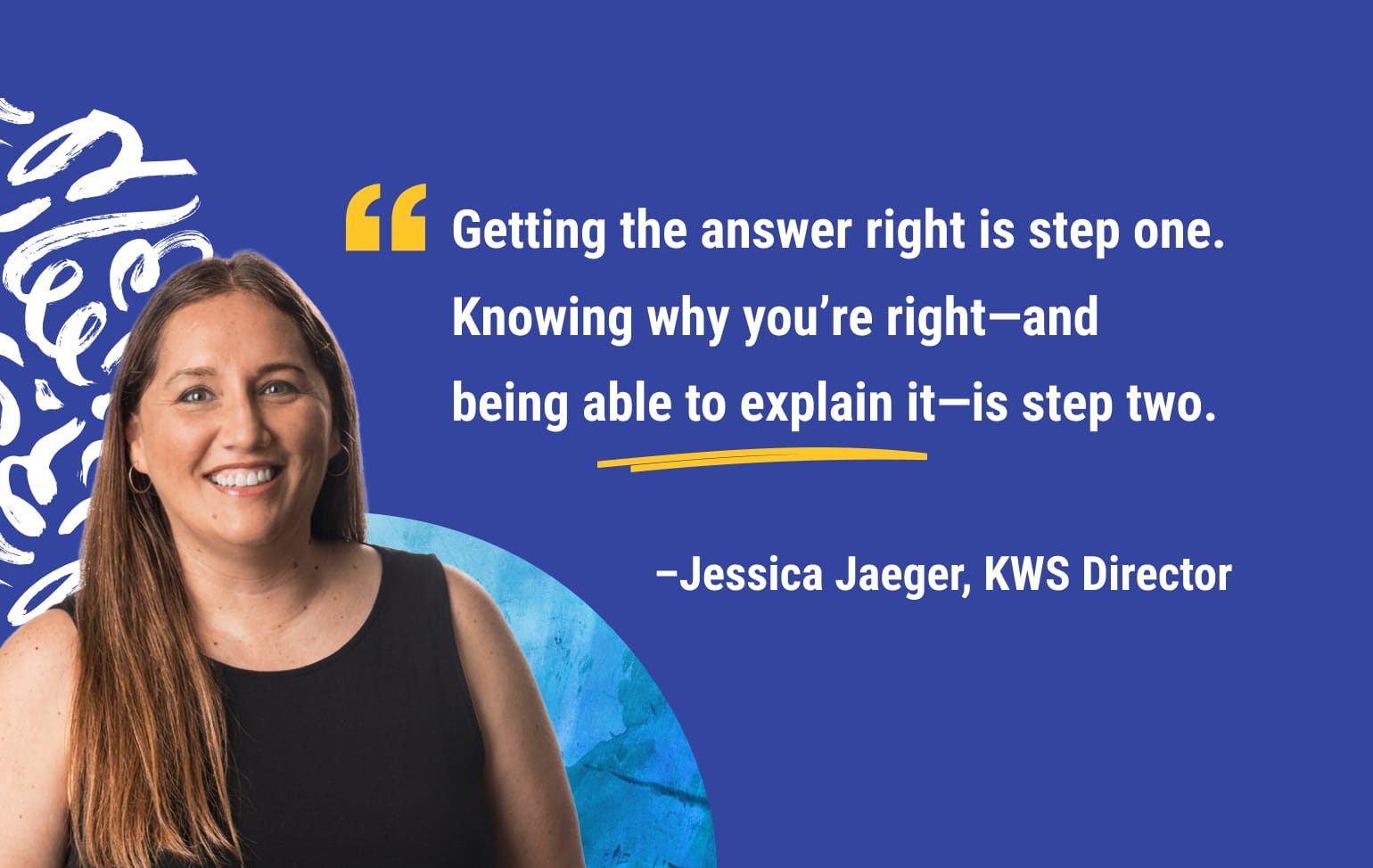
KWS Director, Jessica Jaeger, puts it this way, “Getting the answer right is step one. Knowing why you’re right—and being able to explain it—is step two.”
Signs of Success
Just a few years in, assessment results offer encouraging signs of academic success. The following table highlights results from three assessments that provide different views of KWS student performance.
Even as the program grows, assessment scores are holding steady. While scores like these are encouraging, an even more compelling story is emerging.
Schools for the Future
Khan World School and similar emerging ASU Prep models are challenging the definition of school itself, prompting questions about what students should know and be able to do, particularly in the age of AI.
“How do you know what you know? How do you know what you don’t know?” Jaeger asks. “That’s probably the even more important question.”
Asking students to examine their thinking in this way is no small intellectual task, yet the model requires this precise thing. Drawing from the principles in Sal Khan’s The One World Schoolhouse, students must do more than deliver correct answers. They must understand, articulate and sometimes reconsider the thinking that produced the answers in the first place.
Central to the program are seminars that use Socratic dialogue, requiring students to develop their “thinking muscles.” Students research a topic, take a position, and then discuss and debate it. They may even be asked to argue a position they do not personally hold, stretching their thinking, challenging their assumptions and uncovering flaws in their logic.
“Socratic dialogue … shows us how students are processing information and what questions they have, which helps us identify where they may be stuck,” Jaeger explains.
In a recent seminar, students were assigned the task of researching Denmark and the United States to take a position on where they would prefer to live, based on the respective forms of government, standards of living, values, and other factors. Students have to locate and evaluate source materials, examine data, and consider multiple perspectives before forming and defending a position. Juniors and seniors eventually get to design and lead seminar topics like this themselves.
In short, rather than telling students what to think, teachers support students in their own discovery. In time, students learn to articulate what they know, how they know it, and, equally important, where knowledge gaps remain for them, a critical skill for remaining curious and open to further learning and dialogue.
Emerson Kizer, a senior in the program, reflects on Socrate’s famous saying, “‘I know that I know nothing.”
“Though I’d heard the quote before, I only felt it when I began participating in KWS,” says Kizer. “Being forced to defend my ideas helped me realize that the more I learn, the less I know.” That realization, he says, can produce both “satisfaction and suffering.” But he’s not complaining. He sees it as the path to becoming a well-rounded human being. “I’m certainly better off.”
Structure and Support
KWS combines online flexibility with considerable human interaction. Live online participation is required, high-school classes are generally kept to about 10 students, and students remain with the same seminar cohort throughout the year to foster open and honest discussion.
The role of the teacher has also been redesigned. Rather than simply dispensing expertise, teachers use questions and “wondering aloud” to prompt students and support their discovery process. Teachers also work as a team, crossing traditional departmental boundaries and sharing responsibility for understanding and supporting each student.
Evidence for learning gains extend far beyond transcripts and test scores. Students develop writing portfolios, analyses of full-length works, and applied projects. Over time, graduates have accumulated 30-50 hours of videos of themselves explaining math or science concepts. They read and analyze eight books a year, share discoveries verbally and in writing, and design their own science labs. Reflection, debate, discussion and application provide rich evidence of the depth and breadth of their learning—far better than simple recall or standardized tests.
Learning is intentionally slowed in some ways. Students must attempt every assignment, receive feedback, and potentially try again when they have yet to demonstrate proficiency. In fact, the model normalizes “failure” as part of learning. Success is not rationed through class rankings; every student can reach proficiency and mastery, not just a few top-ranked exceptions. For gifted students who may struggle with anxiety and perfectionism, this structure provides freedom to revisit material without fear.
“What excites me most about Khan World School,” says co-founder Sal Khan, “isn’t the unusually strong test scores. It’s watching students defend an idea, realize they’re wrong, and change their minds. That’s the skill that matters most, and it’s the hardest one to fake.”
Rose Burcusa, another KWS student, echoes that sentiment, saying that KWS helps you as a student to “grow into your own person and form your own ideas and opinions,” while also teaching you to consider facts from more than one side of an argument. The program has also taught her that doing her own research is essential both for school and for life.
Bigger Questions
The success of the model raises the question: Shouldn’t all students have access to a similar environment? Jaeger nods affirmatively but cautions that doing so “requires a mindset shift. What we are battling is the cultural mindset around school and what a grade means.”
Our existing structure of letter grades, grade bands, standardized tests, college-entry requirements and fixed timelines are being challenged by flexible models like KWS. But leaders of such models often find themselves encountering a long-entrenched system built for efficiency, not personalization.
Take the traditional school calendar as an example. Jaeger explains, “You had six weeks to complete this unit. The six weeks are over, so we’re moving on.”
While there are complex and sometimes legitimate reasons schools have operated this way, multiple factors are driving change. Together, forces such as AI, online technologies, demand for choices and for personalized learning, a rapidly changing workforce, and economic pressures will all require us to rethink not just honors programs but entire school models. Where, how, and when learning happens must be reconsidered, along with how learning is demonstrated and how postsecondary admission systems evaluate what students know.
Beyond Scaling
As ASU Prep looks for ways to replicate Khan World School’s success in new models, local needs must be factored in. At The Levitt Lab in Tempe, a hybrid model on ASU’s main campus, direct access to university resources shaped the design. At the same time, the program builds on KWS’s emphasis on community, seminar and self-designed projects. Felix, a new ASU Prep-powered hybrid model at Lasell University in Massachusetts, is exploring elements of mastery and proficiency while addressing state-specific requirements through a different curriculum.
The challenge is not simply to scale programs like KWS or replicate the model intact across the nation. Rather, we’re looking at how we can preserve the rich gains in student agency, relationships, dialogue and individualized feedback that appear central to its success. Some practices may scale readily; others may require deliberate investment in people. Context matters. So do questions about what we can appropriately hand off to AI and what must remain a distinctly human responsibility.

KWS is doing more than challenging assumptions about what constitutes an effective honors program. It is challenging our ideas about school itself. The success of the model pushes us to ask, “How can we make access to this level of teaching and learning available to all?”
As we examine which elements can be easily transferred and which are more challenging, one question remains: What are we, as educators and leaders, willing to change—both in our schools and in our own thinking—to give more students access to learning experiences like these?
Ready to help your student redefine their education?
Learn more about the vision and back story for this innovative program cofounded by Sal Khan.
Watch this video to hear how students experience the program and explore how KWS supports students in grades 6–12 through individualized learning pathways, meaningful projects and a supportive global community.