How to Help Your Student Make the Most of Summer

« Back  |  

Summer is a time to recharge from the busy school year, but it can also be a great opportunity to sharpen your student’s skills while they have some spare time. Whether you have an early learner or college-bound student at home, here’s why you’ll want to consider enrolling your student in one of our 2021 Online Summer School Sessions, and sooner rather than later.

Session 1 runs from June 1 – June 25, with the last chance to enroll on May 7. Session 2 runs from July 12 – August 6, with the last chance to enroll on June 18.

Catch up
This past year has made it hard on students and parents to maintain a normal momentum with curriculum learning. Online summer school can make up for lost time and bridge any learning gaps that happened as a result of the COVID-19 pandemic.

Get ahead
Our online program covers essential math and reading material your student can expect to face in the upcoming school year. Each course is targeted to your student’s level of learning from K-12, comes with live and digital lessons that can be completed any time, and only requires 2-4 hours of work each day.

Math Momentum, our summer math program, is a great way for students to accelerate their math skills with the help of our expert online teachers. High school students can choose from Algebra 1, Algebra 2 or Geometry.

Reading Refresh is perfect for students who want to improve their English reading skills. Your student will be required to take a preliminary reading assessment, which will help our instructors create a personalized lesson plan.

Students in grades 6-12 also have the opportunity to register for ASU Prep Digital online high school courses over the summer, a great way to get ahead .

Keep busy
Any parent knows that the summer months can be the hardest when it comes to keeping your student occupied. School’s out, and while summer camp is a great option for some, summer school can actually be a better choice for busy parents. You won’t have to worry about recurring fees or dropping off and picking up your kids every day. They can participate in our classes at home in just a few clicks. That guarantees hours of stimulating course material for your student, and much more me-time for you.

Tuition is the same for all K-12 offerings and simply depends on what type of student you are. Full-time ASU Prep students and Arizona private school students can register for online summer courses tuition-free. Part-time Arizona public and private school students pay $200 per course, per session. Out-of-state and international students can also attend for $275 and $600 per course respectively.

Stay sharp
Online summer school is a great way to help your student stay sharp. Studying even just a little through the summer will prevent any kind of learning gap between last school year and the next.

Our online summer school program is designed to keep your student focused by offering two short sessions for them to choose from. That way they don’t have to commit to a full season of learning—just enough to keep them engaged in time for the new school year.

Prepare for college
Our online summer school program can help your high school student get ready for—or get a jumpstart on—college. Students in grades 9-12 are eligible to participate in concurrent university courses online, designed to help them graduate early and earn college credit in high school. Explore the full catalog of online college courses here.

Ready to register your student? Enroll now. Not sure what session or courses are right for your student? Learn more about ASU Prep Digital online summer school here or talk to an advisor.
Remote, Online, and Virtual: Cousins not clones!

« Back  |  

By Julie Young, Managing Director, Arizona State University Prep Academy, and VP of Student Education and Outreach at ASU

Originally published April 19, 2021 on digitallearningcollab.com

The wholesale jump to remote learning in 2020 will be remembered for many reasons, some positive and some painful. On the upside, our nation’s teachers, students, and families gained valuable skills and experience using 21st century technologies to support learning. On the downside, no one in distance education would have recommended the shocking pivot to this entirely different way of learning without design, training, transition planning, and preparation. It was truly a worst-case scenario, and what passed as “online or virtual learning,” left many with an understandably bitter taste.

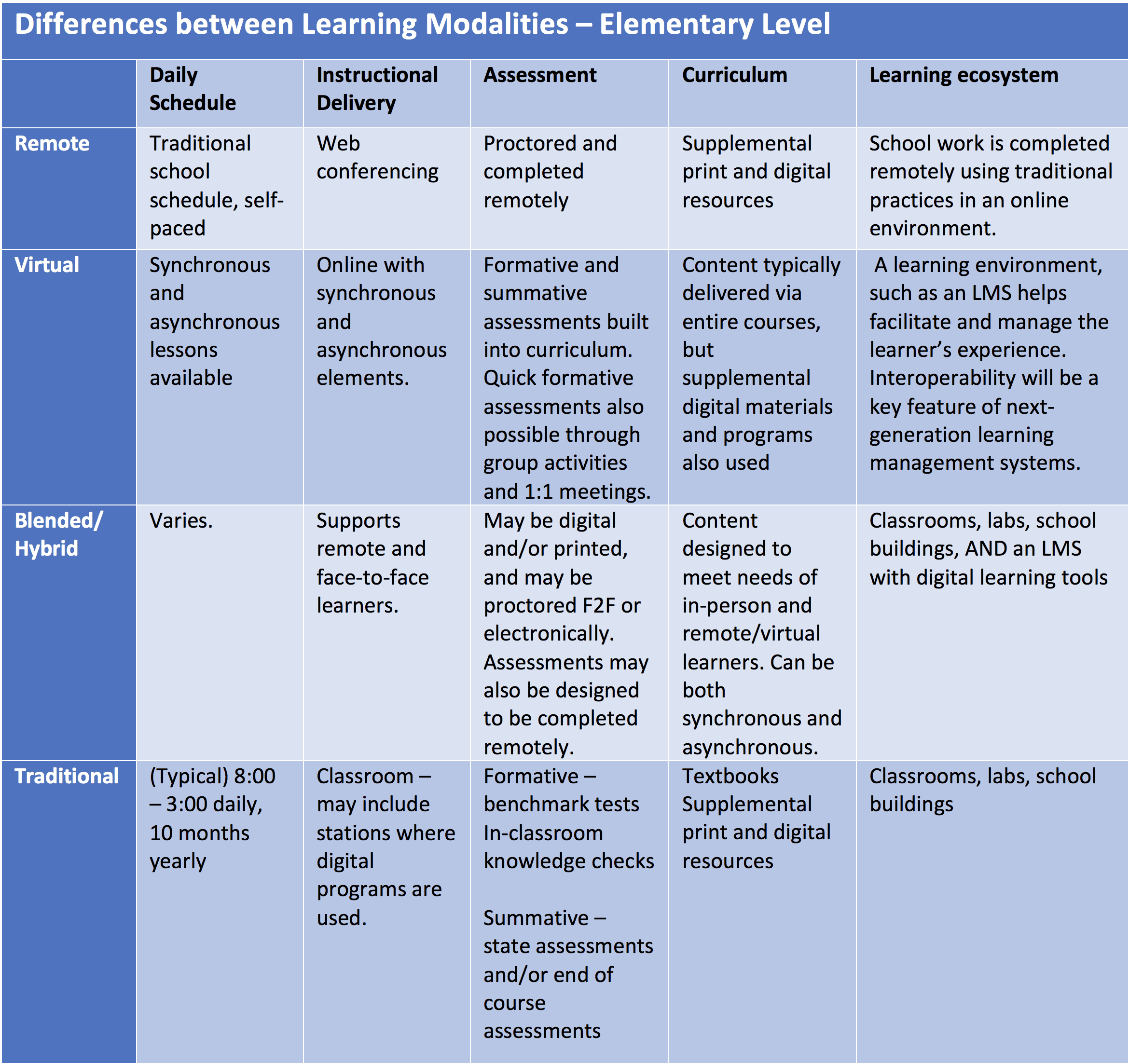
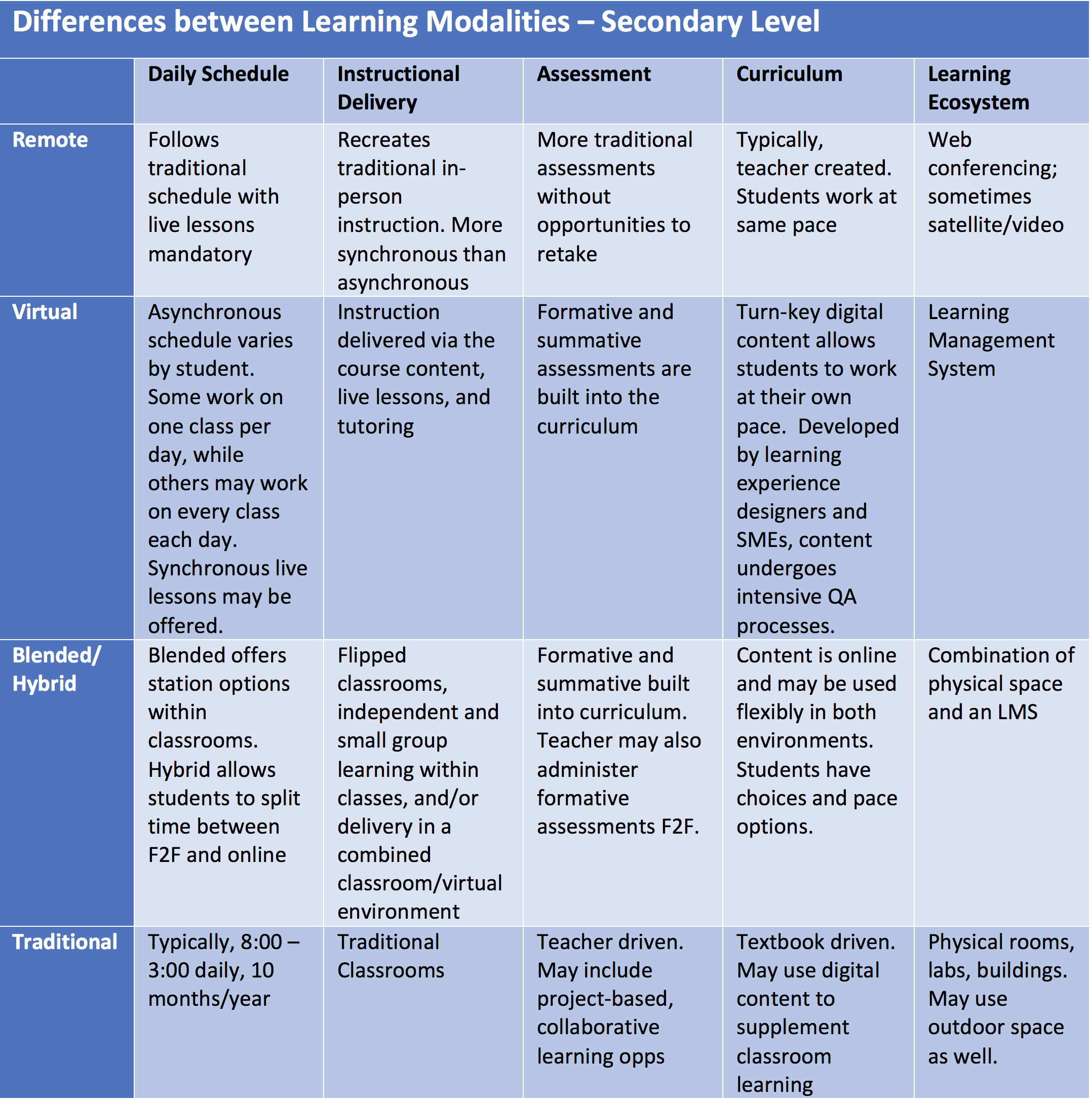
Even with the knowledge and skills gained relative to tech-based educational tools, there is still a serious lack of understanding about the differences between Web 2.0 tools and a well-designed virtual learning model. Perhaps it is time to put a finer point on defining remote, online, and virtual learning. I like to call these terms “the 3 cousins” because they are related but they are not the same. (Note that “digital learning” is often used as an umbrella term, with “digital” similar to “online” referring to the technology.)

Let’s start with remote learning. This is exactly what most of the world’s students experienced during the height of the pandemic. Remote learning simply transfers whatever happens in a classroom to a Zoom screen for learners outside of the physical classroom. For example, what was once a classroom lecture may now be nothing more than a talking head in a web conference. Many students experienced a “Brady Bunch” web conferencing screen for extended hours at a time, which is a poor simulation of a classroom. This may work in a short-term pinch, but remote learning is not what a long-term, well-designed virtual learning program should look like.

The term “online learning” simply refers to the vehicle or the educational medium for instruction to take place. In other words, the learning, regardless of where it takes place, is delivered via online tools and systems. Again, “online learning” is not the same as a well-designed virtual learning ecosystem, complete with thoughtful, research-based instructional practices, curriculum designed for online delivery, and student support mechanisms specific to the virtual learning environment.

Learning via a virtual versus face-to-face environment is obviously different. While the pandemic required educators to immediately use whatever tools they had at their disposal, for long-term virtual learning, it is reckless to simply transfer or replicate classroom learning to the online environment without employing thoughtful, design thinking. Quality virtual learning is designed learning, whether the end goal is a completely online, virtual, hybrid or blended model.

The differentiator for quality is in the learner experience. Learners in a quality virtual model should have much more agency. Time should become a variable, while learning remains the constant. The content and instructional design should invite and cultivate personalization, such as choices in pacing, scheduling and response choices. A well-designed program incorporates the power of adaptive content and assessments and offers varying learner pathways, depending on individual readiness and levels of mastery. Great design offers more flexibility for 1:1 or small group teaching and tutoring, and those sessions are far more richly informed by just-in-time, actionable data, readily available in a web-based environment.

To add to what educators have gained during this pandemic, I would suggest a few questions to consider. For example, how can the next virtual learning environment you create be designed so that what we see is less “teacher talking” and more “students doing,” in the form of peer collaboration, project-based learning, “away from computer” independent discovery, and family or community engagement? How can we staff to maximize student contact and support a “high touch” environment where students are always connected to life lines? How might a reduction in teachers’ time on writing lesson plans and grading be spent on individualizing learning? What are the best strategies for maximizing shorter synchronous times?

How do you incorporate counseling support, and what do things like homeroom, clubs, or extra-curricular activities look like in virtual programs? How can you strengthen relationships with students and families? Hint: none of this is about more social media. We often tell our teachers, “The phone is your friend.” Sometimes a simple phone call to a concerned parent or student can calm mountains of fears and anxiety!

Proven techniques and strategies already exist to address these questions and more, but this is where planning and training enter the picture. Virtual learning should incorporate ongoing coaching and training for teachers and program developers, particularly around design thinking. The details involved in crafting elements to support the learner experience in a virtual or hybrid delivery model are too seldom considered, partly due to lack of experience designing tech-supported learning models.

Still, now that educators have a taste of both the advantages and challenges of virtual learning environments, the need for support and training has increased. Incorporating the work of qualified instructional or “learning designers” will facilitate elevated levels of program design. But we will also need to cultivate and encourage a spirit of innovation if we are to realize high quality virtual learning models that equal or surpass the models we’ve known to this point—whether traditional or virtual. Let’s not settle for “going back to the way things were.” Let’s move forward to something better, using strong student support and thoughtful design as our building blocks.

Meet an ASU Prep Digital Student with Super Powers

« Back  |  

Check out this article about Neva Lee Recla, one of our amazing students, previously published in “Podcast Magazine”:

Witty, wise, and eloquent. Author, entrepreneur, mentor, and podcaster.

Meet Neva Lee Recla, an 11-year-old student in Arizona.

Like many girls her age, she attends school virtually, is active in her church, and dreams of going to college. Then, there are the many ways she shines brilliantly, like a supernova traveling through the universe.

For the Recla family, podcasting is a family affair. They created the SuperPower Network in January 2016, and Neva’s mother, Tonya Dawn, was the first to host a show. Then, at the age of seven, Neva decided she wanted to follow her podcasting mother’s example and host her own show. She asked her mother if she could, and remembers her mom “looking at me like I was crazy. Like, ‘How is my seven-year-old daughter going to do a podcast?’” She was actually a little reluctant at first.

“My mom said, ‘I don’t want to coach kids.’ I explained to her that I was going to be the one who coaches them. We talked about it more, and she agreed. When I first started Super Power Kids, I had no clue what I was doing. I copied everything my mom said and memorized her exact intro.”

To see the complete article from “Podcast Magazine”, visit their web site.

Why Do Students Prefer Online Learning?

« Back  |  

Even before COVID-19 disrupted the way we educate, more and more students were seeking an alternative to the brick-and-mortar learning environment. Whether they wanted to take charge of their education or carve out more time for themselves and their hobbies, students discovered a different style of learning could be the key to their success both in and out of the classroom.

Let’s take a look at some of the reasons why students prefer online learning:

Personalized learning paths.

Education is not ‘one size fits all.’ One major reason why students prefer online learning is because it takes a personalized learning approach, ensuring that every student can be successful. Many online high schools, including ASU Prep Digital, leverage individualized teaching models and technologies to assess student needs, strengths, weaknesses, and learning styles. This allows students to work at a pace that’s comfortable for them without feeling like they’re behind or  they’re moving too far ahead.

Flexible schedule.

In a traditional school setting, students are busy from morning until night. Between attending classes at set times, participating in extracurricular activities, and completing homework assignments, their schedules are jam packed and the same day after day. Another reason why students prefer online learning is because it gives them the flexibility to create their own schedule, allowing them to make more time for themselves and the things they love to do. Students at ASU Prep Digital enjoy working at their own pace and scheduling time to complete assignments while pursuing their passions, whether it’s music, dance, or athletics

Varied learning environment.

Now more than ever, it’s important to make multiculturalism and supportiveness a priority in our classrooms. One of the unique advantages to online learning is the opportunity to connect with, and learn from, peers all around the world. At ASU Prep Digital, students are exposed to different cultures on a daily basis, allowing them to expand their horizons and make new friends that may be states or even oceans away! In fact, ASU Prep Digital offers a Global Leadership Exchange elective course where students collaborate with peers at Lydex High School in Morocco, developing important skills and establishing deeper understandings of different perspectives and cultures.

For students who are looking to learn at their own pace, set their own schedule, and have time to pursue their passions outside of school, online learning is a great option. Be sure to check out these additional posts to learn more about why students prefer online learning:

Tips to Stay Connected in an Online Learning Space

« Back  |  

With so many schools switching to virtual or hybrid learning environments within the past year, students and teachers alike are looking for ways to stay connected in an online learning space—and in this new normal. We’ve rounded up some of the best tips that you can start implementing now:

Join or start a club

One of the best ways to stay connected with your peers is to join a school club based on your interests. Many established online schools, including ASU Prep Digital, offer a variety of extracurricular activities for students, including a school newspaper, book club, and student government. Does your school offer online clubs? Start your own! You can even work with your teacher or counselor to offer it schoolwide.

Host virtual events

If you’re looking for a way to include many students at once, hosting a virtual event is a great place to start. From trivia and movie nights, to live speakers and talent shows, there is no shortage of things you can do to bring the student body together and have some fun. You can even send out a poll asking students what events they’d be interested in to make them part of the process.

Create a Facebook group for your class

Want to stay connected after class hours? Set up a Facebook group! This will allow you to plan virtual study sessions, virtual lunches, and get to know your classmates better. And if you’re a teacher, this can be another way to communicate any important information with your students or even plan fun activities, such as virtual field trips or in-class celebrations.

Set up a weekly video chat with friends

Not being able to hang out with your friends in person doesn’t mean you can’t see them! Set up video chat dates with your friends to check in, catch up on life, and share some laughs. There are plenty of apps you can use, such as Zoom and Google Meet, and some even have games you can play together, like House Party. Whether you have a 1-on-1 call with your best friend or host a virtual game night with your group, it’ll be a nice break from texting all the time!


Check out these other posts for tips on how to socialize and stay connected in an online learning space:


ASU Hosted Drive-In Events to Aid Students in Filling out FAFSAs

« Back  |  

*This was previously published on Ed Scoop and written by Betsy Foresman

Arizona State University hosted several drive-in events to help students fill out their Free Application for Federal Student Aid forms last week, setting up Wi-Fi hotspots and printers in a parking lot where volunteers assisted families in the financial aid application process.

Typically, workshops and office hours would provide in-person, individualized help to students and their families who are filling out the FAFSA form for grants, scholarships and federal loans, but university leaders said the pandemic forced it to take a different approach this year.

“If students don’t fill out FAFSA, they leave significant funding on the table for college,” Sylvia Symonds, Arizona State University associate vice president for outreach, said in a press release. “FAFSA completion is so critical for educational opportunities, and it creates a ripple effect in families’ economic futures.”

For the drive-in events, which were hosted by ASU and the Be a Leader Foundation, an organization that supports college applicants, vehicles arrived at several Phoenix-area high schools where ASU staff were waiting to provide assistance. Wi-Fi hotspots in the parking lots allowed applicants to connect to their online FAFSA forms, and printers and personal devices were also available to students and their families if needed.

“Many schools are not doing in-person FAFSA events, and students are missing out on the in-person help,” Shayne Johnson, an outreach coordinator for College Success Arizona, which helped organize the events, said in a press release. “In order to stay safe yet still serve students we felt like a drive-in event allowed us to reach the maximum number of students.”

The drive-in events last week assisted more than 70 cars of students and their families, according to ASU. Several additional drive-in events are scheduled for February.

Students can also receive help through a FAFSA hotline or though the university’s Benji chatbot, a tool the university says can answer more than 600 questions about the federal aid application.

Top Five Tips for Teaching Online in 2021

« Back  |  

We know that 2020 was a challenging year for educators as they juggled pivoting to virtual instruction while ensuring their students had a smooth transition as well. As we look to the spring semester and beyond, we’re excited to share our Top Five New Year’s Resolutions for Teaching Online in 2021.

This ten-minute video training will share best practices from teachers all over the US, from building a strong, inclusive community for your online classroom, to creating better video content that will keep students and families engaged. You’ll learn ways to strengthen your skills while picking up a few new tricks to ensure a successful school year.

Want an in-depth look at our top five tips for teaching online? Check out our video to learn how you can start the new year with a collection of useful tools under your belt.