How College Preparatory Programs Are Helping to Democratize Education

« Back  |  

ASU Prep Digital and Miami Junior Senior High School Are Building a Next-Generation Classroom To Provide Additional Options to Students in a Rural Area

For many, the American Dream has a similar highlight reel during high school: four years spent making friends, discovering yourself, creating lifelong memories and, most importantly, preparing for college. Across the U.S., test scores and grade point averages consume student minds as they thumb through college pamphlets and mull over majors.

Unfortunately, this American Dream is not accessible to everyone. Due to a lack of academic resources, many high school teachers woefully watch promising young students give up on their college careers long before they’ve had a chance to unfold.

That’s where digital college-preparatory schools like ASU Prep Digital (ASUPD) come in. These institutions are stepping in to provide the academic support and programming necessary to empower students from all walks of life on their distinct paths toward collegiate success.

ASU Prep Partners with Miami Junior Senior High School

In the fall of 2017, ASUPD partnered with Miami Junior Senior High School in Miami, Arizona, to rejuvenate the academic potential of their students. The odds of going to college were stacked against the students of a town with a median family income of approximately $30,000, an unemployment rate of about 45 percent, and very few college graduates.

ASUPD trained Miami High’s teachers to use a blended learning to adopt a modern teaching style that caters to each student’s pace. Fueled by a shared passion for the future of these bright and often-overlooked teenagers, the program has a goal of building the next-generation classroom. The program has thus far been a success with students and families from surrounding communities expressing interest in taking part.
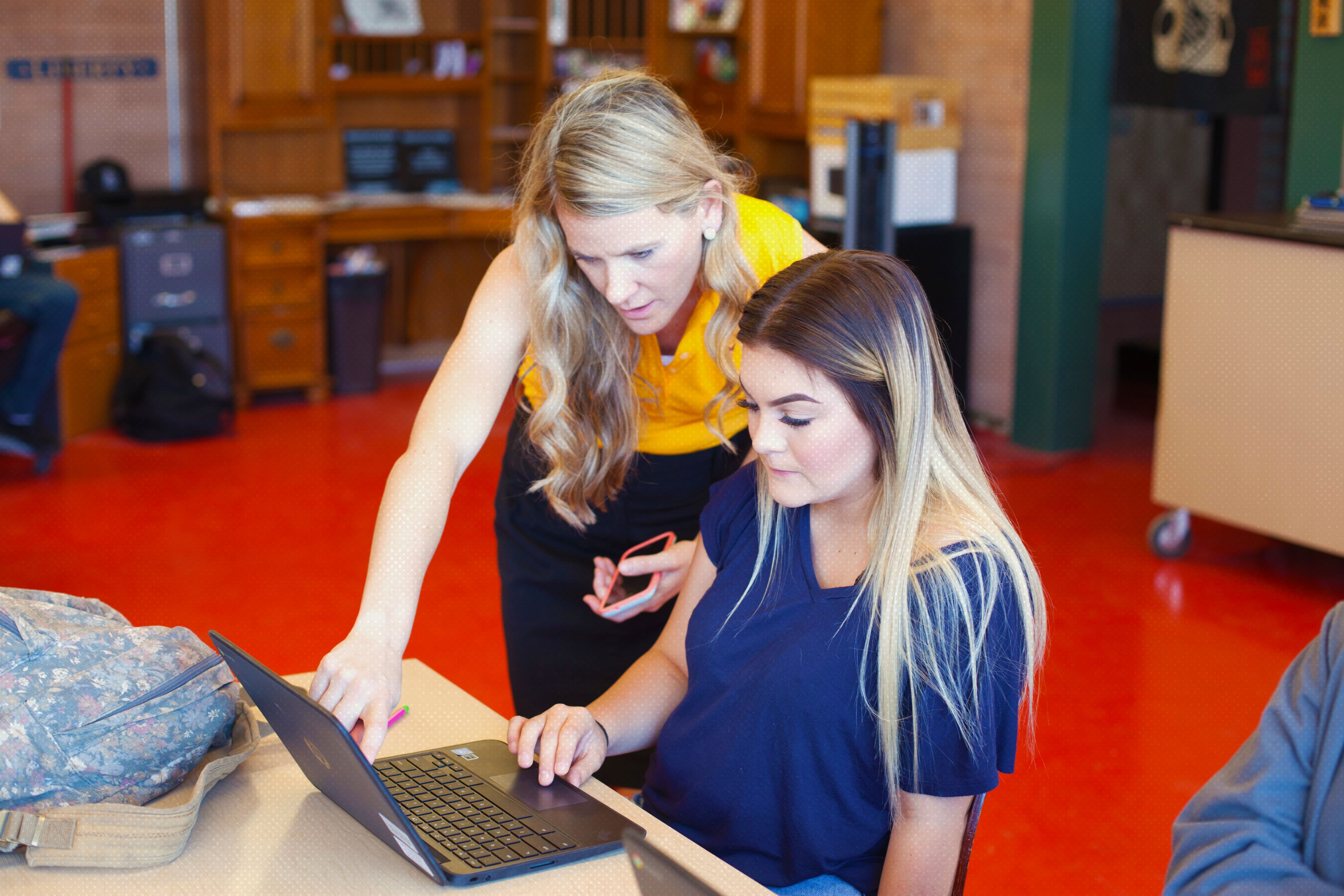
Miami Junior Senior High School Next-Generation Classroom

Bridging the Gap

The impact of this kind of immersive scholastic program extends far outside the classroom walls. Students who once felt helpless in commanding their future are now privy to an academic world once reserved for more privileged institutions.

According to Eugene J. Cornacchia, Ph.D., giving high school students access to college prep classes ignites within them a hope of achieving the American Dream, a dream that “however imperfectly realized it may be at times, has nonetheless been the engine of wealth generation, innovation, and upward mobility. But a college education has important non-economic benefits, as well: an engaged citizenry, healthier lives, and commitment to volunteerism, to name just a few.” In other words, these programs have the potential to permanently alter the course of these students’ lives.

And the positive effects of this next-generation classroom seem to ripple beyond the students themselves, ultimately affecting families and entire communities.

As a part of ASU PD’s partnership with Miami High, student Alexandra Anaya participated in the American Dream Academy, which offers resources for families who want to become versed in the college application process. Students learn how to apply to and pay for college, as well as the necessary steps to take before enrolling.

After finishing this course, Alexandra’s newfound confidence spread to other members of her family. Alexandra’s sister, Daisy, had graduated two years earlier but never applied to college out of fear and uncertainty. This program was the catalyst for Daisy’s academic success as she completed her first semester at Arizona State University the following spring.

Starting New Traditions

Many underserved high school students feel excluded from the college experience because it veers from their family’s long-steeped traditions. Often coming from homes that emphasize blue-collar jobs, these students don’t see themselves as fitting the “collegiate mold.” But according to an article in The New York Times, “Nearly 60 percent of admissions directors said they were likely to increase their recruiting of first-generation students this year,” indicating the tides are changing for these students.

These same students are energized to be the first in their family who can proudly sport collegiate attire. “Our students really felt like they were Sun Devils from day one, when lead teacher Mike Kasper and ASU Prep Digital Director Jill Rogier arrived to the school with bags of swag for the kids and spent a day walking them through online classes,” explains Miami High principal Glen Lineberry.

Generating a Bright Future

Rural communities across the nation have faced the problem of academic disappointment for quite some time. Principal Lineberry notes that the change in culture, economy, and education has widened the gap between rural school systems and their suburban and urban counterparts. Programs like ASUPD’s are transforming outdated curriculums and bridging long-standing socioeconomic divides. Next-generation classrooms and college prep programs illuminate a different path forward for students.

Findings by Pew Research Center reinforce that “on virtually every measure of economic well-being and career attainment—from personal earnings to job satisfaction to the share employed full time—young college graduates are outperforming their peers with less education. And when today’s young adults are compared with previous generations, the disparity in economic outcomes between college graduates and those with a high school diploma or less formal schooling has never been greater in the modern era.”

For too long, students across the country have watched the door shut on their college dreams. Institutions like ASUPD are opening these doors and building new portals for success.

To learn more about ASU Prep Digital and the program implemented by Miami Junior Senior High School, contact us here

Top 7 Things They Don’t Want You to Know About Taking Online Courses

« Back  |  

“Take a course to get ahead!” They say… but really, what’s the deal with online high school? Virtual schools are everywhere, but most people aren’t telling you the real reasons to try it.

Don’t like to wake up early? Online courses are ready when you are.

No joke. Taking online high school classes means you work when, where, and how you want. Not an early bird? Log in at noon—your English class is ready for you. Have plans tonight? Log in to get some work done when you get home—your math class is always open. Schedule flexibility is one reason so many students and families are taking their high school classes online. 

Online classes can help you graduate early.

By taking additional credits alongside your high school work, you have the opportunity to graduate early, which means more time to pursue what you love. Maybe you want to work more hours, start college sooner or maybe you’re the youngest pro tennis player ever and you need more time to practice. Take some online classes and you can work toward earning your high school diploma and graduating as soon as you’re ready.

Online does not mean working alone.

It’s not the 90s anymore—online learning doesn’t happen in an isolated underground computer lab. When you take an online high school class, you join a community of learners. You have a real teacher, there are real students to collaborate with, along with clubs and activities to take part in. This connection can feel deeper than traditional courses because in an online school much of the teaching is one-on-one, it’s all about you. 

You can boost your GPA!

Many online schools offer Advanced Placement, Honors and even dual enrollment or concurrent enrollment college-level courses, which can give your GPA the boost it needs to be competitive for college. If your local school doesn’t offer these courses, online high schools (like ASU Prep Digital) may be a way to get the weighted credit that can really help out your GPA.

On the other hand, if you’ve failed a high school course, online learning means you won’t be held back.

Everyone makes mistakes. Before online high school classes, failing a class could have meant being held back and missing out. Now, by retaking that dreaded class online, you may be able to replace the course you failed without repeating it at school.

Online learning helps students figure out how the adult world works.

Much of adult life happens online. From banking to interviews and even remote work, people today have to figure out how to use so many different systems to get through life. Students who take online classes learn how to navigate unfamiliar situations and working environments like they’re a breeze! Taking a virtual high school course means that you’ve got a jump start on adult life—it’s an online class benefit that they don’t tell you about. 

Get a head start toward college.

Want to get ahead of the competition when it comes to college admission? Start college courses while you’re still in high school. A few online high schools offer dual enrollment courses, allowing you to receive college credit from a local community college. You don’t have to drive to your local campus anymore to get the benefits. Better yet, ASU Prep Digital offers concurrent enrollment, allowing students anywhere in the world to be enrolled in both high school and Arizona State University classes at the same time. These University courses count for high school and college credit. And because ASU is a Level 1 Research University, the credits transfer anywhere. Completing these online courses will prove to any college admissions staff you’re ready for the challenge and will save you time and money when you arrive on campus with some of your courses already done.

We understand if you still have fears about taking online courses. While online learning isn’t for everyone, taking even a few virtual high school courses can help you catch up, get ahead or jump start your GPA. Educate yourself about your options and what online learning is really like.

ASU Prep Digital is one way to get there. Learn more, at asuprepdigital.asu.edu


Originally published on September 7, 2017

Old Enough: Why Age Doesn’t Matter

« Back  |  

How ASU Prep Digital Allows Students to Learn Dynamically

Everyone has heard of students who have transcended the boundaries of age: the high schooler who starts her own business, the middle schooler who enrolls in online high school courses, the retiree who gets her high school diploma. These paradigm-breakers resist the traditional age expectations assigned by the year they were born. They do the work at their own pace of intelligence and go where their life calls them. Can you imagine what we could achieve as a culture if all people viewed lifelong learning this way? 

Those who have reached beyond their age are often labeled prodigies or phenoms. No doubt when you hear these stories, you remember back to your own experience in school. How many of us have felt held back when we had an intellectual leap that our peers did not? Or, maybe we watched as our peers moved ahead while we needed a little more time.

Some learning models naturally accommodate these leaps and pauses in the spectrum of learning and living. Multi-age classrooms or one-room schoolhouses follow the child through their learning, encouraging individualized paths. But the larger and more regulated educational systems became, the more out-of-focus the student appeared. This isn’t blame-placing; traditional educational systems operating at capacity often struggle to resist mission drift. 

In my world, age matters a little less than it does in other places. At ASU Prep Digital, students progress at their own pace through online high school and concurrent enrollment in college courses. It’s the expectation, not the exception. By getting what society perceives as a head-start, ASU Prep Digital students benefit from being seen apart from the norm — giving them a distinct, concrete advantage when they apply to college. And perhaps most importantly, by eliminating age as a construct in learning, students are empowered to shape their worlds and contribute to the global community.

To break the paradigm of age as a barrier – and as a construct – on a systemic level is an absolute game changer.

There is no more effective way to change the world, at both the community and global levels, than to liberate our students of all ages to learn faster, better, and smarter. More and more, the workforce of today is dynamic. The career you start will likely not be the career from which you retire. Or maybe, you don’t retire at all but instead, continue to work well into retirement age.

This concept of moving forward—beyond age, to allow each student to work toward their goals at a pace that matches their needs and ambitions isn’t new, but there are very few places in the world where this is the standard instead of a deviation. ASU Prep Digital is growing exponentially to meet the needs of the students and families who see this opportunity for what it truly is—the ideal way to educate students for a dynamic workforce. 

To learn more about ASU Prep Digital and their teaching model, read this blog post.  

The Concurrent Enrollment Experience

« Back  |  

Taking College Courses in High School

High school has evolved since the days of our parents. We no longer have to follow the same track. Our schooling isn’t limited by old notions that high school means following a traditional curriculum. In fact, many students are discovering that they can get a head start on college by taking concurrent enrollment classes while still in high school.

Concurrent enrollment is an excellent option for high school students, which allows them to enroll as non-degree-seeking students at a university and take courses for full credit (while also receiving high school credit needed for graduation). The opportunity to enroll concurrently isn’t always available with online programs – but schools like ASU Prep Digital, which is chartered by Arizona State University, have found ways to make this option accessible on a global scale.

A concurrent student example

Jerah Francone, a high school senior at ASU Prep Digital, is concurrently enrolled in ASU’s Exploring Sustainability Science course, taught by professor and Director of Research and Development, Annie Hale, and designed under the leadership of 2001 Nobel Prize-winning scientist Lee Hartwell.

Jerah said he likes the class because it corresponds to interests outside the classroom. One example comes from Jerah’s entrepreneurial mindset. He freelances as a digital marketer and is currently helping a start-up guitar company in Kentucky. The company is looking for ways to get wood from the community for the guitars they craft. Jerah is able to correlate what he’s learned in Sustainability Exploration to the work he does for the guitar company. The production of a single guitar involves hundreds of different systems.

“Everything is connected, and I’ve been able to take what I’m learning in the class, see how everything corresponds to each other, and how the ecosystem is being affected.”

– Jerah

Explore your future major

As a student taking ASU courses, while finishing his high school courses at ASU Prep Digital, Jerah said he is using this time to explore possible college majors.

“A lot of times, when kids are going into college, they don’t know exactly what they want to do, so being able to take concurrent enrollment classes can help them hone in,” Jerah said. “For me, it’s been a good experience because I’ve taken these classes, and I’m like, ‘okay this is what college is going to be like, and if I like this section, then maybe I should go into something like this.’ So, it gives us more of a first-hand experience with college, in a low-risk environment, since it’s still high school.”

Professor Hale agrees. She explained that ASU Prep Digital students attending university classes, like hers, will be able to get a taste of what life is like after high school. It helps to demystify college a little bit. And because ASU attracts online students from all over the world, ASU Prep Digital students might have classmates in Arizona, the east coast or even Beijing.

Sustainable conversations

Jerah’s online sustainability class is built in a digital storytelling format; incorporating compelling and engaging videos that speak to course topics. There is no textbook or long required reading assignments, it’s all about watching and reacting to the videos that highlight real-world events shaping our society and planet. Hale, and the team at the Biodesign Institute at ASU, have created these videos to engage learners in an interesting way. Jerah and other students in the online class are then invited to form and share their perspectives on what they are learning through assignments that go beyond traditional writing prompts.

Ultimately, the goal is to apply those learnings to the world at large.

“I think it’s a really great class for an ASU Prep Digital student audience because it’s video-based and it’s really fun,” said Hale.

“Every video has become an interdisciplinary course brought to you by experts across the fields of sustainability, education, science, and technology studies to create a holistic perspective of sustainability…”

– Professor Hale

She went on to explain, “…we designed the course in such a way that students can engage with ideas from a variety of different experts and perspectives. We never want it to be ‘here’s what sustainability is’ but rather here’s the conversation about sustainability,”

Ultimately, when students complete their concurrent course for the semester, they leave with a richer understanding of how to be a successful college student.

“What we are teaching will benefit students in all areas,” Hale said. “If you’re a high school student and you’re learning about these concepts now, you are transformed by having this knowledge. You’re suddenly a different freshman at ASU or any university. You’re armed with the ability to critically analyze and explore and articulate about the world around you, and that is really what every college class wants you to do.”

To learn more about concurrent enrollment courses, read this blog post

A Day in The Life of an ASU Prep Digital Student

« Back  |  

So you’re thinking about enrolling in college classes online, as a high school student? You may have questions about how this new process will work within your current reality. What can you expect your day to look like as a part-time and full-time ASU Prep Digital student?

Let’s look at a day-in-the-life of an ASU Prep Digital part-time and full-time student.

Part-Time Students:

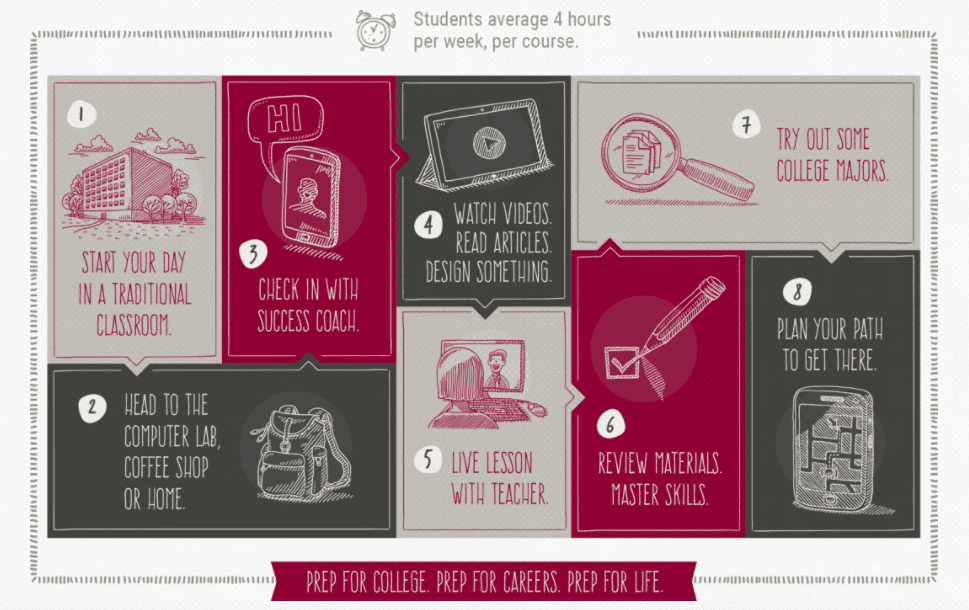
Students can usually plan on spending about 4 hours per week, per course. You may start your day going to a traditional high school or homeschool situation. Then at some point, head over to a coffee house, library or back home to start your online coursework.

Part-time students will typically start their ASU Prep Digital work by logging into their student dashboard to check for updates or messages from their personal success coach, teachers or fellow students. It’s important you take a minute to reply to those messages and check-in with your coach and teacher with any questions or concerns — then jump into some coursework. This can involve watching course videos, reading articles, reviewing course modules and working on outstanding lessons. Each week your teacher will host a live video forum which you can join or watch the recorded version at their convenience.

If it is an exam week, you may spend time studying on your own. Then, once you’re ready, you’ll log in and complete the exam online. All tests are open-book, but require higher-level thinking to answer questions.

Being a part-time student at ASU Prep Digital is convenient and challenging — giving you a taste of what learning at the college level is like, all from the comfort of your own home…or favorite coffee shop.

Typical Day for a Part-TIme Student

Full-Time Students:

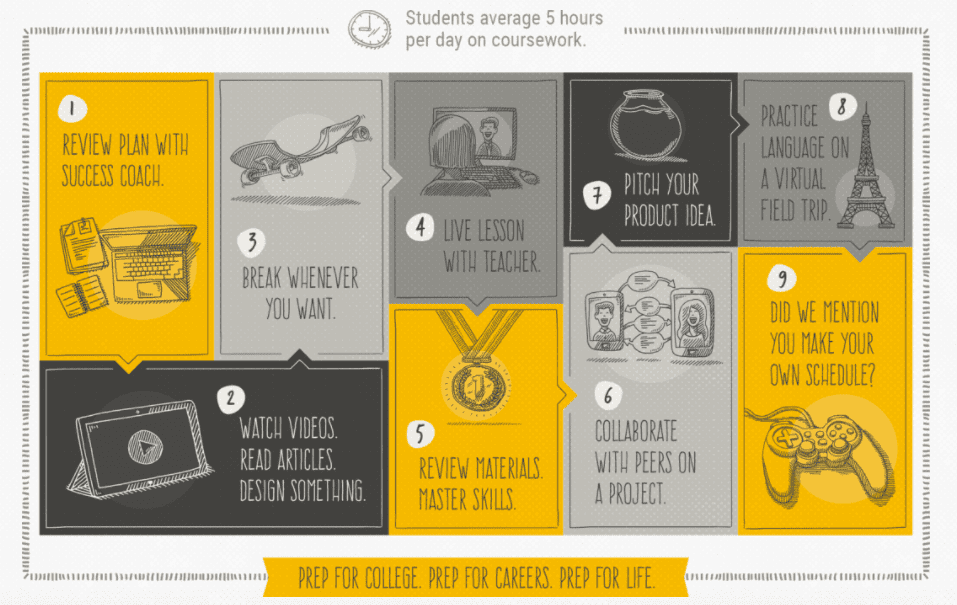
A typical day as a full-time student is really similar to being a part-time student. If you’re taking 4 courses or more you can usually plan on an average of 5 hours of class-time per day. The great thing is that you can do this whenever and wherever you want. You may work a part-time job or play competitive sports and it’s easy to schedule your class work around your shifts and practice schedule.

Your daily routine consists of checking in with your success coach and teachers, as needed, to get a pulse on how your pacing your way through each course and working out the plan that you created at the beginning of the semester. Then balance your time between working through lessons, watching course videos and reading materials that relate to your subjects. You’ll have weekly live lessons with your teachers and you may even schedule a chat with them if you’re in need of additional help in a particular subject.

In a full-time environment, you will have the opportunity to collaborate with your peers on projects, develop products or business ideas, present them as part of your coursework, and even take virtual field trips to different countries (as part of your language course). Assessments are done throughout the semester and typically follow the pattern of a college term: quizzes, tests, mid-term exams, and finals.

Typical Day of a Full-Time Student

Every day is different and affords each student incredible opportunities to develop their leadership and critical thinking skills. Take a break when you need to. Meet a friend for lunch in between lessons – it’s totally up to you and when you work best. You literally get to set your own schedule and with the help of your teachers and success coach, you can customize an online learning experience that works for your life.

To learn more about online learning or about ASU Prep Digital, visit our website or read more posts on our blog.

Our Teaching Model

« Back  |  

The ASU Prep Digital Teaching Model

One of the biggest fears people have when considering an online education is that “students are all alone.” And we hear you.

It’s true that 100% of coursework is online and it can be done from virtually anywhere, but despite the persistence of the myth… you’re certainly not on your own.

At ASU Prep Digital, students are intentionally connected with qualified teachers, a personal success coach and fellow students throughout an entire course experience.

The ASU Prep Digital teaching model l is one-of-a-kind, in that it creates a very personal and helpful environment to support the student — with real teachers and coaches. The model is built around a personalized learning approach; which means each student’s individual needs are assessed and, how best to help them succeed throughout their course, is customized. After a student enrolls, their success coach will work closely with them, their teachers and even their parents to develop a plan that will help them to achieve their goals and stay on track.

Newly enrolled full-time students start by attending a week-long orientation course, taught by their success coaches. The course covers topics like: how to set-up your home classroom/office, how to take a screenshot, how to submit coursework and questions to your teacher, taking ownership in decision making, leadership development, and growth training.

Throughout the semester, the success coach provides a holistic perspective of the student’s overall course load and reminds them of critical dates, like registering for the PSAT and filling out college applications.

This is done in an initial connection through both phone and email, making communication convenient and personal for you and your family.

ASU Prep Digital teachers are not average — no really! Each teacher makes a personal investment in their students, creating great dialogue around what their interests and goals are for each class and how they can help them be successful. Each teacher reaches out to both the student and the parent(s) at the start of a new course and welcomes them to the class via email, phone call and sends them a welcome video message through Adobe Connect and/or YouTube.

Each teacher usually touches base with students about 3 times each week;

especially if they see that a student is lagging behind or made a failing grade on a quiz or test. That said, they don’t just follow up to tell the student that they failed, but rather, they provide feedback, offer resources for better understanding and create inroads to help students process their progress and make adjustments as needed. You rarely get that kind of one-on-one care in most traditional classroom settings.

Teachers host a weekly live video that usually lasts between 30-45 minutes. This gives an overview of coursework for the week and helps students assess where they are in the class. Students are also encouraged to connect with their teachers via email, chat, phone or text whenever they need to, to get their questions answered.

Though much of online learning is independent for a student, ASU Prep Digital has created a leading model of digital community and connection that is unprecedented. Find out more about the advantages of the ASU Prep Digital Teaching Model.

What is Personalized Learning?

« Back  |  

Personalized Learning

When you hear the term “personalized learning,” most people’s minds conjure images of 1:1 classrooms or customized lesson plans, not online education. The common assumption is that learning online means working on your own to complete a series of general courses, in an effort to get credits, a degree or supplemental learning of some kind. Few people would pair the term personalized learning with online high school courses.

The truth is, many online schools have the ability to provide valuable tools and individualized experiences for high school students. Making the online learning an ideal platform for personalized learning.

So, what do we mean when we say “personalized learning?” Every year, iNACOL (International Association for K-12 Online learning) speaks with thousands of online educators, in an effort to get a clear understanding of what personalized learning means to them. They define it as:

“Tailoring learning for each student’s strengths, needs, and interests – including enabling the student’s voice and choice in what, how, when and where they learn – to provide flexibility and supports to ensure mastery of the highest standards possible.”

Let’s break this down.

Personalized learning means tailoring to each student’s needs and interests. In an online learning environment, there are several ways that this is accomplished, but it can really be boiled down to two main influences — teachers and tools. At ASU Prep Digital, the personal touch begins with the teacher and success coach assigned to each student. When a student enrolls in a new course, the teacher reaches out to them and their parents with a personal phone call and e-mail.

Throughout the course experience, teachers and success coaches have the ability to customize modules and learning experiences for each individual student — based on their needs and abilities. If a student already understands a topic, they can move onto the next module without having to wait for an entire classroom to catch up. If they need more time, they can take it and work with their teacher to get the extra assistance they need. This allows for a tailored and flexible learning experience.

ASU Prep Digital teachers and coaches are accessible to students throughout the entire semester; connecting with students via chat and text and offering 1:1 instruction when it’s needed most. In addition, teachers host weekly live video discussions. By providing this opportunity to connect in small groups, students are encouraged to ask questions and participate in topic discussions. Therefore, the teacher’s role extends beyond providing assignments and grades. It is focused on helping students to gain knowledge and understanding of their coursework.

The online tools are a close second to teachers, and help to provide a truly customized experience.

New technology, such as the me3 application, uses the student’s interests to help them discover a potential college major and future career path. There are also unique tools made available in every course, allowing for students to connect with their teachers as well as collaborate with one another; such as Adobe Connect, Facebook Live and Canvas modules for coursework and group projects.

In addition, ASU Prep Digital plans to release Virtual Reality experiences as another tool for students to explore subjects such as Biology, Chemistry, History, and English. The VR lessons allow students to interact in their course subject as a character in a larger narrative — collecting facts, taking risks and having fun — all while learning!

The most compelling aspect of creating a personalized learning experience is the convenience for the student — they literally can learn from anywhere and on the schedule that works for them. Learning is not compartmentalized anymore. Students can learn as they live. Today, online learning provides students with the support and motivation to be independent learners and thinkers in this modern-age, while following a curriculum that is tailored to their specific needs and abilities.